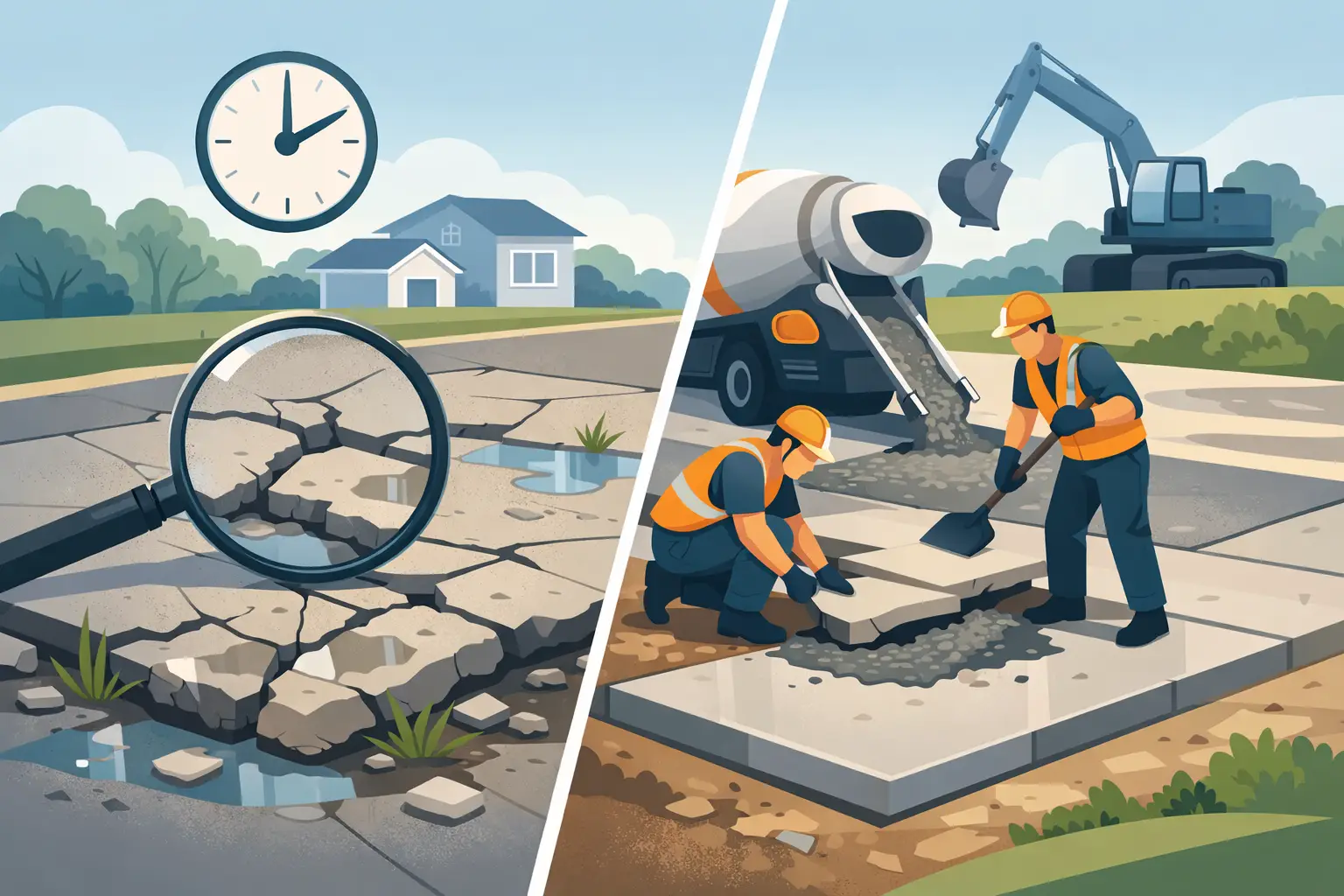
A slab that has dropped an inch near the garage door does not automatically need to be torn out. In many Omaha-area homes, the better question is when to replace concrete slab sections and when leveling can still solve the problem safely and at a lower cost. The right answer usually comes down to cracking, drainage, soil movement, edge support, and whether the slab is still structurally worth saving.
The real question is not just damage
Homeowners often focus on the visible symptom - the trip edge, the standing water, the gap by the porch, or the driveway panel that no longer meets the garage floor. Contractors look at something slightly different. They want to know whether the slab has mainly settled, or whether it has broken down to the point that lifting it will not hold or will not make sense.
That distinction matters because settled concrete can often be raised. A slab that is heavily fractured, eroded underneath, or affected by broader structural movement may be a replacement candidate instead. The surface can look rough in both cases, which is why photos alone do not always tell the full story.
When to replace concrete slab areas instead of lifting them
Replacement becomes more likely when the slab has lost its integrity, not just its level. A few common situations tend to push a project out of the leveling category.
The concrete is badly broken, not just uneven
A slab with one or two stable cracks is very different from a slab that has shattered into multiple loose sections. If pieces are rocking independently, corners are broken off, or the surface is crumbling around the cracks, lifting may not restore enough strength. Mudjacking or foam raising works best when the slab is still largely intact and can move as a unit.
This is common on older walkways, thin patio sections, and areas that have seen repeated freeze-thaw wear. In those cases, even if the slab can technically be lifted, you may still be left with weak concrete that continues to deteriorate.
The slab was poured too thin or built poorly
Some replacement decisions are really construction quality decisions. If the slab is too thin for the load it carries, has poor reinforcement, or was poured on weak base prep, leveling addresses the symptom but not the underlying limitation. A driveway panel that supports vehicle traffic is held to a different standard than a rear patio with light foot traffic.
If the original slab never had enough thickness or support, contractors may recommend replacement so the base and pour can be corrected at the same time.
Drainage is actively undermining the slab
Water is often the hidden reason concrete sinks in the first place. Downspouts dumping next to a patio, soil washout near a sidewalk, or poor grading along the garage apron can remove support under the slab over time. If that erosion is severe, simply raising the concrete may not be enough.
Sometimes leveling still works after drainage correction. Sometimes the slab has been undermined so badly that replacement is more practical, especially if edges are broken or voids are extensive. The key issue is whether the support conditions can be stabilized.
There is major heaving, settlement, or movement tied to other structures
Not all slab movement is isolated. If porch slabs are pulling away from the house, if attached steps are rotating, or if a garage floor shows signs of broader foundation-related movement, the project may need a wider review before anyone recommends lifting or replacement.
This does not always mean a foundation failure, but it does mean the concrete symptom may be part of a larger issue. In those cases, replacement alone is not necessarily the answer either. The point is that slab replacement makes more sense once the full cause is understood.
When leveling is often the better option
Many exterior concrete problems in eastern Nebraska are settlement problems, not full replacement problems. If the slab is still intact, lifting can restore function without demolition, hauling, curing time, and a full repour.
A good candidate for leveling usually has moderate sinking, limited cracking, and solid concrete overall. Common examples include a driveway panel that settled near the garage, a sidewalk section that created a trip hazard, or a patio slab that now pitches water the wrong direction. In those cases, the slab itself may still be usable if support is restored underneath.
This is why homeowners should be careful not to assume that ugly means unsalvageable. Staining, minor cracks, and uneven joints may look severe from the curb, but they do not always require replacement.
Signs your concrete may still be worth saving
If you are trying to judge the issue before requesting quotes, look for a few practical indicators. One is whether the slab feels solid underfoot or under vehicle weight. Another is whether the cracks are limited and relatively tight rather than wide, offset, and crumbling. It also helps if the slab remains mostly in one piece.
Water behavior matters too. If the main issue is that the slab has settled and changed drainage direction, raising it may correct the slope. If water is washing out soil from below, you may need both leveling and drainage work. That is different from replacement for replacement's sake.
How contractors think through replacement versus repair
A contractor is usually weighing three questions at once. First, can the slab be lifted? Second, should it be lifted? Third, what result is realistic after lifting?
Those questions are not identical. A sidewalk section may be liftable, but if it is extremely worn and near the end of its service life, replacement may still be a cleaner long-term choice. On the other hand, a newer driveway panel with settlement but minimal cracking may respond well to leveling and save substantial cost.
Expected appearance is part of the decision too. Leveling can improve safety and drainage, but it does not erase existing cracks or make old concrete look new. Some homeowners care most about function. Others are planning a sale or want a more uniform finish, which can make replacement more appealing even when lifting is technically possible.
Omaha-area conditions that affect slab decisions
In the Omaha metro, soil and weather both matter. Expansive soil, seasonal moisture swings, freeze-thaw cycles, and runoff patterns can all contribute to slab movement. That is why two homes with similar-looking driveway settlement may not get the same recommendation.
A slab in Omaha or Council Bluffs that settled from minor soil consolidation may be a straightforward lift. A patio in Blair or Springfield with ongoing water discharge against the edge may need drainage correction before any repair lasts. A garage approach in Glenwood that has broken from repeated vehicle loading may lean more toward replacement.
Local quoting gets better when homeowners share details like where the slab is located, how much it appears to have dropped, whether water pools nearby, and whether there are nearby downspouts, retaining walls, or hard-to-access areas.
What to check before you request quotes
You do not need to diagnose the slab perfectly, but a little preparation helps. Measure the worst height difference if you can do so safely. Note whether the concrete is at a driveway, sidewalk, patio, porch, garage, or steps. Take clear photos from a few angles, including close-ups of cracks and wider shots that show drainage and surrounding grade.
It also helps to note if the slab has moved recently or if the problem has been stable for years. Fast change is a different concern than long-settled concrete. Mention if doors scrape, if water runs toward the house, or if the slab has visible voids underneath.
That is the kind of project information local contractors need to sort out whether leveling is realistic or whether replacement deserves a closer look. Omaha Slab Repair exists to help organize that information and route it clearly, not to act as the contractor itself.
A practical way to decide when to replace concrete slab sections
If the slab is intact, usable, and mainly suffering from settlement, start by exploring leveling. If the slab is broken apart, too thin, badly undermined, or tied to a larger structural or drainage issue, replacement becomes more likely. The gray area is real, and that is where accurate photos, site details, and local evaluation matter most.
The goal is not to force every slab into the cheaper option or the more drastic one. It is to match the method to the actual condition of the concrete. A good repair decision fixes the problem you have, not just the symptom you can see from the driveway.
If you are unsure, focus on documenting the slab clearly and describing what has changed. That usually gets you closer to a useful answer than guessing whether the only choices are lift it or replace it.