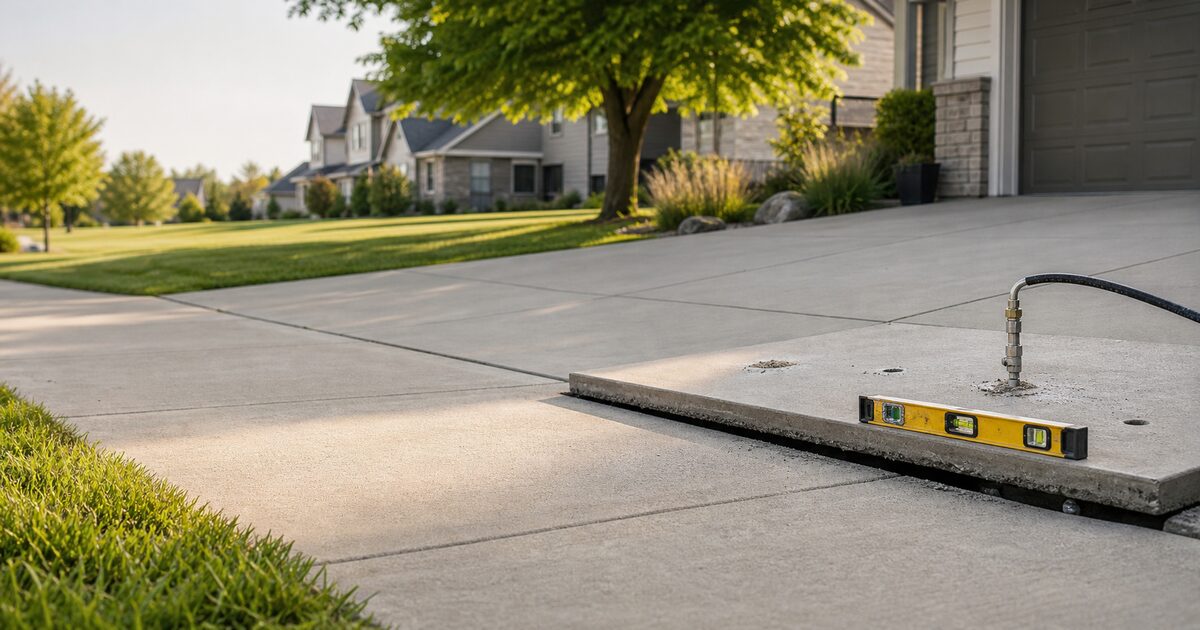
Mudjacking and foam lifting solve similar problems in different ways.
Both methods can raise settled concrete without replacing the whole slab. The right method depends on slab condition, access, budget, soil movement, drainage, and contractor equipment.
- Method fit
- Cost ranges
- Drainage
- Quote questions
Prefer to call? (402) 347-7788
Quick Method Comparison
The right method depends on what failed: the concrete surface, the support below it, the water path around it, or a small edge that only needs to be reduced.
| Method | Often fits | Watch-outs |
|---|---|---|
| Mudjacking | Settled slabs that are mostly intact, especially larger driveway, patio, or sidewalk panels. | Uses a cement-based slurry. It may need larger holes and can be heavier than foam. |
| Foam lifting | Slabs where a lighter lift material, smaller holes, and faster cure time are useful. | Can cost more and is not offered by every contractor. |
| Replacement | Broken, crumbling, heaved, heavily cracked, or poorly supported concrete. | More disruptive, but sometimes the only durable fix. |
| Grinding | Small sidewalk lips where reducing a raised edge solves the immediate trip hazard. | Does not correct the settled slab or the drainage cause. |
| Sealing and drainage work | Joints, cracks, downspouts, or water flow that may keep undermining the slab. | Usually supports the repair rather than replacing lifting or replacement. |
Measure The Drop Before Comparing Methods
A quote conversation gets more useful when the request includes the surface type, the amount of settlement, and a photo that shows scale. A straight board, level, tape measure, or ruler can make the drop easier to understand.
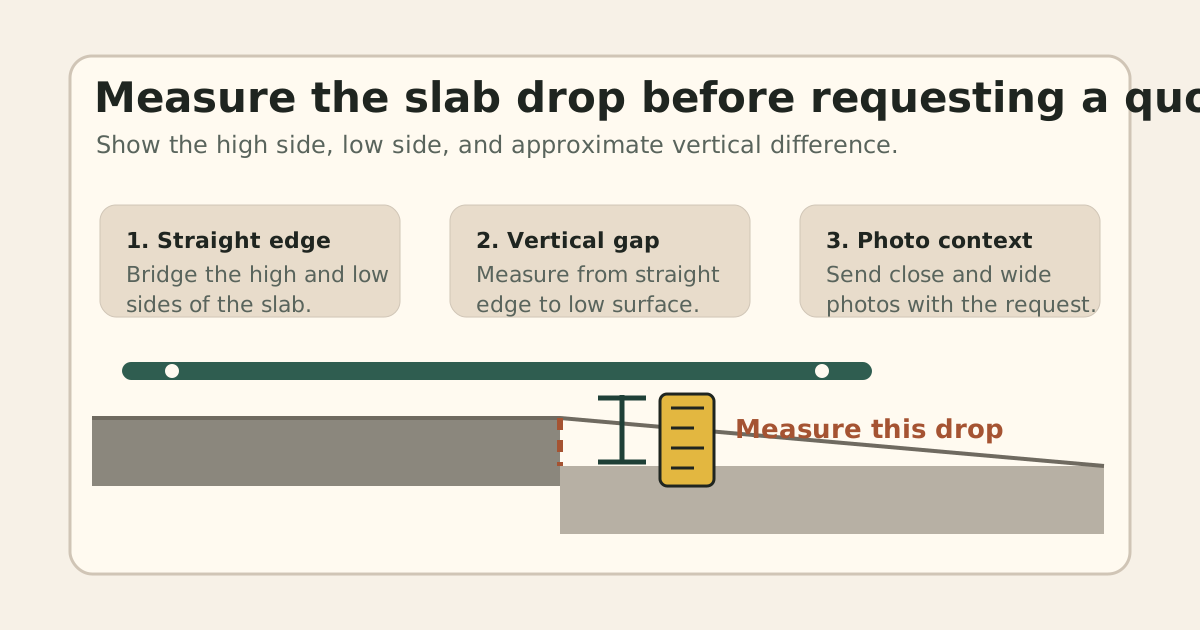
- Take one wide photo of the whole driveway, sidewalk, patio, garage approach, or step.
- Take one close photo showing the high edge, low edge, crack, gap, or garage lip.
- Measure the approximate drop and include whether the slab still drains away from the house.
- Mention whether cars, snow removal, strollers, wheelchairs, or daily foot traffic use the area.
Mudjacking Vs Foam Lifting Process
Mudjacking and foam lifting both use drilled holes and injected material, but the materials behave differently. Mudjacking uses a cement-like slurry. Foam lifting uses expanding polyurethane foam.
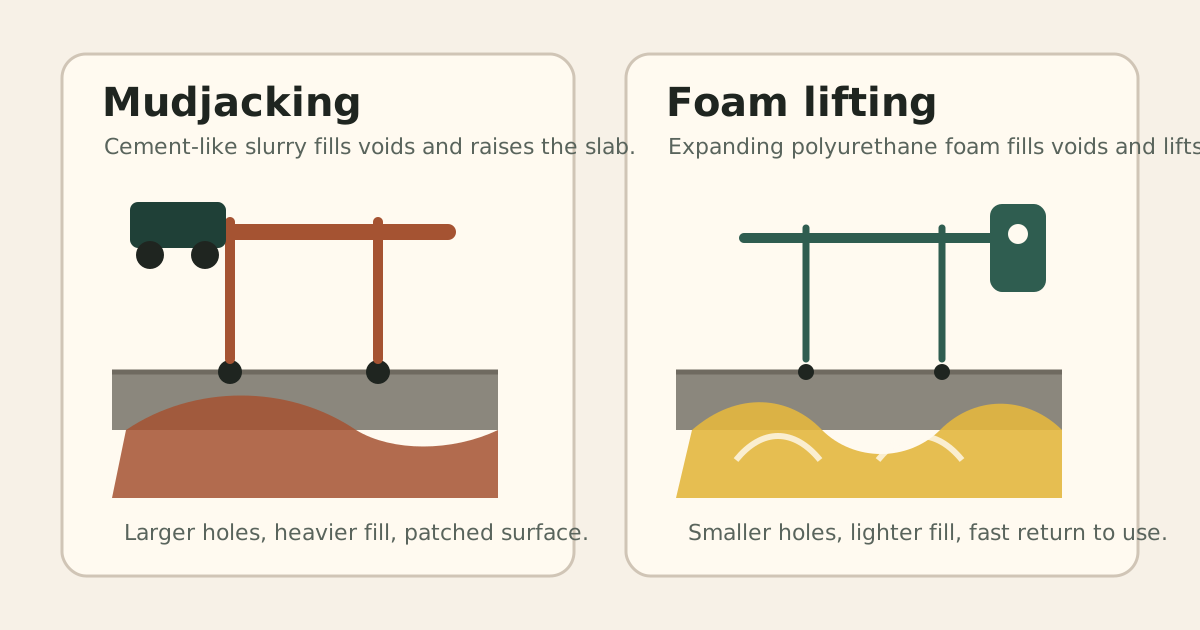
- Mudjacking may be practical for larger driveway, patio, sidewalk, and garage approach slabs when access is straightforward.
- Foam lifting can be useful when smaller injection holes, lighter material, cleaner access, or fast return to use matters.
- Both methods still depend on the slab being mostly intact and on the base below it being stable enough to support the repair.
- Ask whether patched holes, cleanup, joint sealing, or crack work are included in the quote.
Omaha Metro Fit Notes
Around Omaha, method fit often comes down to freeze-thaw exposure, wet soil or clay-heavy fill, old garage backfill, downspout direction, and whether a crew can reach the slab without damaging the property.
- Driveways: compare how the method handles vehicle load, garage lips, snow-removal edges, and water moving back toward the garage.
- Patios: ask whether the slab can be lifted while preserving slope away from doors, siding, and foundation walls.
- Garage slabs and aprons: show door gaps, apron drops, water entry, and any cracks near the garage wall.
- Sidewalks: include trip-edge height, public sidewalk limits, tree roots, and whether grinding or replacement is safer than lifting.
- Access: mention narrow gates, steep side yards, landscaping, hose distance, alley access, street parking, and turnaround space.
Cost Ranges Are Starting Points
Published cost guides are useful for orientation, but they are not a substitute for a local estimate. Minimum charges, slab size, lift height, access, material, cleanup, and drainage work can move the quote outside a simple per-square-foot range.
| Repair path | Published starting range | Why the local quote can change |
|---|---|---|
| Mudjacking / slurry lifting | Often shown around $4-$9 per square foot in published guides. | Small jobs may hit a minimum charge; deeper voids, access, patching, and cleanup can change the number. |
| Foam lifting / polyjacking | Often shown around $8-$25 per square foot in published guides. | Foam material, equipment, injection pattern, cure time, and precision lifting can affect cost. |
| Replacement | Usually quoted as a separate remove-and-repour project. | Demo, disposal, forming, base reconstruction, drainage, thickness, reinforcement, and finish all matter. |
Drainage Can Decide The Repair Plan
Leveling can raise the slab, but it does not automatically stop water from softening or washing soil from the slab edge. If water is part of the problem, the durable answer may include downspout work, joint sealing, regrading, or drainage review.
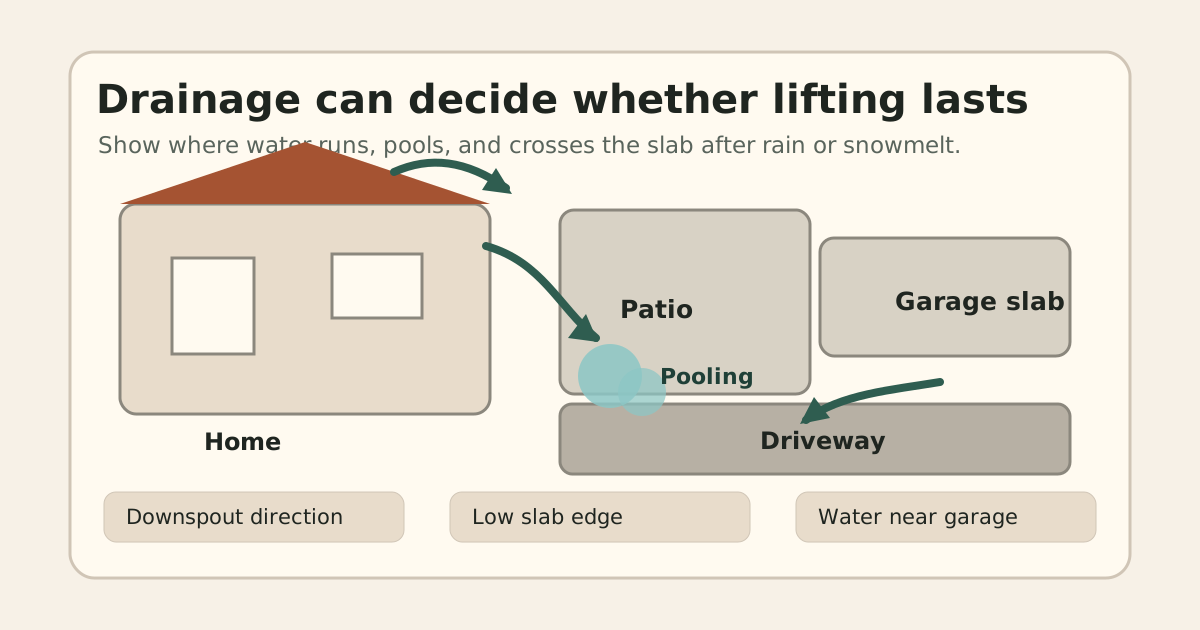
- Mention downspouts that discharge next to a driveway, patio, sidewalk, or garage approach.
- Show where water pools after rain or snowmelt, especially at the low edge of the slab.
- Ask whether open joints or cracks should be sealed after lifting.
- If water runs toward a foundation, garage, or door threshold, ask whether drainage work should happen before or alongside lifting.
Durability And Re-Settlement Risk
No lifting method is permanent when the original cause keeps moving soil away. The best quote explains what could make the slab settle again and what is included to reduce that risk.
| Repair path | Durability question | Re-settlement concern |
|---|---|---|
| Mudjacking | Will the added slurry weight matter for this slab and soil condition? | Water, weak backfill, or voids outside the injected area can allow future movement. |
| Foam lifting | Is foam the right density and injection pattern for the voids under this slab? | Poor drainage, broken concrete, or unsupported edges can still shorten the repair life. |
| Replacement | Will replacement rebuild the base and slope, or only replace the surface? | A new slab can fail if base prep, drainage, thickness, or joint layout are wrong. |
When Lifting Is Not Enough
Lifting is not the right answer for every slab. Some conditions point toward replacement, drainage work, foundation review, or a different professional opinion before a concrete leveling quote.
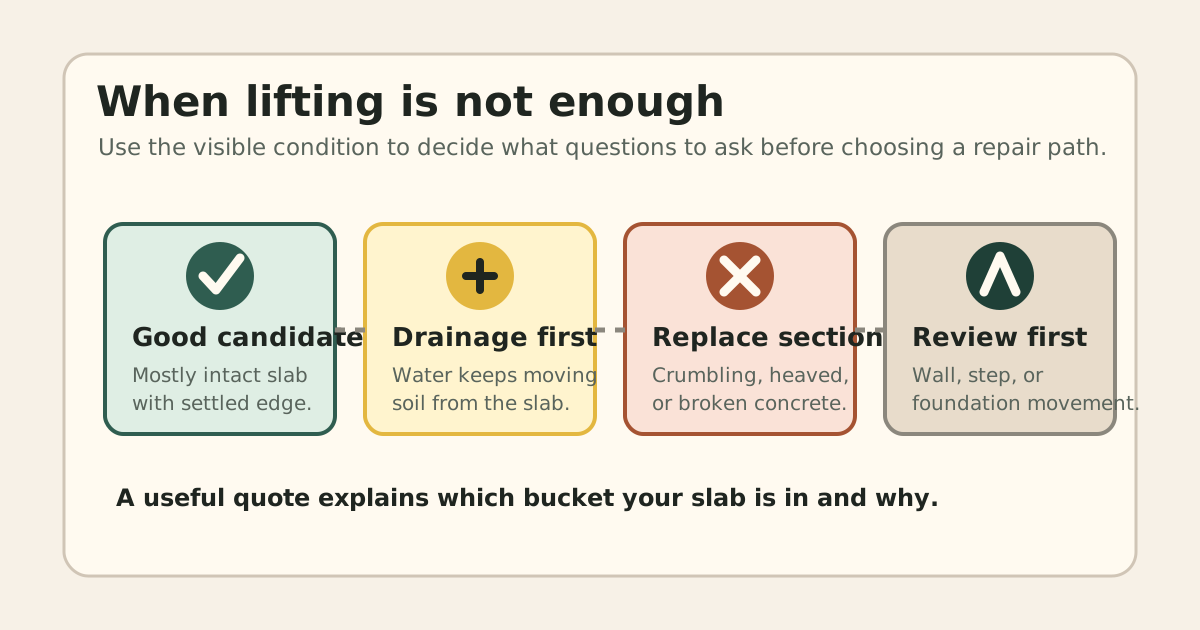
Know the red flags that may point toward replacement, drainage work, or another professional review.
Is my sunken concrete serious?Use a practical severity checklist for trip hazards, drainage, step gaps, and garage lips.
Questions to ask a contractorAsk about method fit, drainage, minimum charges, access, cleanup, and what is not included.
Cost factorsSee why slab size, lift height, access, method, and add-on work can change a quote.
Apply The Method To The Surface
A method that fits one slab may not fit another. Use the surface guide that matches the driveway, garage slab, patio, sidewalk, step, or porch before comparing quotes.
For dropped driveway panels, garage lips, vehicle bumps, pooling water, and snow-removal edges.
Garage slab levelingFor garage floor settlement, apron drops, door gaps, vehicle transitions, and water moving toward the garage.
Patio concrete levelingFor settled patios, outdoor walkways, drainage toward the home, and gaps near doors or steps.
Sidewalk concrete levelingFor sidewalk trip hazards, raised edges, walkway settlement, and accessibility concerns.
Step and porch settlementFor porch gaps, step movement, entry slab settlement, and conditions that may need broader review.
Ask Method-Specific Quote Questions
The right quote should explain why the method fits the slab, what material is being used, what conditions are excluded, and what cleanup or warranty language actually means.
- Why are you recommending mudjacking, foam lifting, grinding, replacement, or drainage work for this slab?
- What material will be injected, and how do you decide the injection-hole pattern?
- How do you check for voids, unstable edges, or a base problem that lifting will not solve?
- Will the quote include patching injection holes, sealing joints, filling cracks, cleanup, and disposal?
- What drainage work should be done before or after the lift?
- What does the warranty cover, and what conditions would void it?
Ask about method fit, drainage, minimum charges, access, cleanup, and what is not included.
What photos should I send?A four-photo guide that helps a contractor understand the slab before an estimate.
Request a quoteSend the surface, city, photos, measurements, drainage notes, and timing in one request.
Use The Local Page With The Method Page
Location can change access, drainage, freeze-thaw exposure, and contractor availability. Pair the method comparison with the page that best matches the property.
For city driveways, garage approaches, sidewalk trip hazards, patios, steps, and drainage-sensitive slabs around Omaha.
Concrete leveling in Council Bluffs, IAFor river-influenced drainage, older neighborhoods, and settled slabs on the Iowa side of the Omaha metro.
Concrete leveling in Blair, NEFor longer drives, detached garages, sidewalks, acreage access, and freeze-thaw slab movement around Blair.
Concrete leveling in Glenwood, IAFor hillside drainage, patio slope, driveway settlement, garage approaches, and entry slabs around Glenwood.
Mudjacking in Springfield, NEFor Sarpy County corridor properties with mixed urban-rural settlement patterns between Omaha and Lincoln.
Frequently asked questions
What is the difference between mudjacking and polyjacking in Omaha?
Mudjacking uses a cement-like slurry. Polyjacking, or foam lifting, uses expanding polyurethane foam. Foam often uses smaller holes and can return to use quickly, while mudjacking may be practical for larger slabs. The best choice depends on slab condition, soil movement, drainage, access, and contractor equipment.
Is mudjacking or foam lifting better for Omaha winters?
Both can work when the slab is a good candidate. Omaha winter performance depends less on the method name and more on whether the slab is intact, water is controlled, joints are sealed when needed, and the base below the concrete is stable.
How much does concrete leveling cost in the Omaha area?
Published guides often show mudjacking around $4-$9 per square foot and foam lifting around $8-$25 per square foot, but local quotes can vary. Minimum charges, access, lift height, drainage, patching, cleanup, and add-on work can matter more than the square footage alone.
When should I choose replacement instead of lifting?
Choose replacement when the concrete is badly cracked, crumbled, heaved upward, or the base has failed. Lifting works best when the slab itself is still mostly intact but has lost support underneath.
Will the slab sink again after mudjacking or foam lifting?
It can if the original cause is still active. Poor drainage, open joints, soft soil, unstable backfill, and water moving under the slab can all shorten the repair life. Ask what could make the slab move again and what work is included to reduce that risk.
How Omaha Slab Repair works
We are a transparent quote-connection guide, not a concrete contractor. Homeowners submit details (surface, location, photos, drainage notes) so available local or regional leveling contractors can respond with useful next steps. We do not perform repairs or guarantee outcomes.
This model keeps the information neutral and helps you get better quotes by sending contractors the details they actually need.
Ready for contractor quotes? Use the form above. The details you send help us route your request to available local leveling teams.