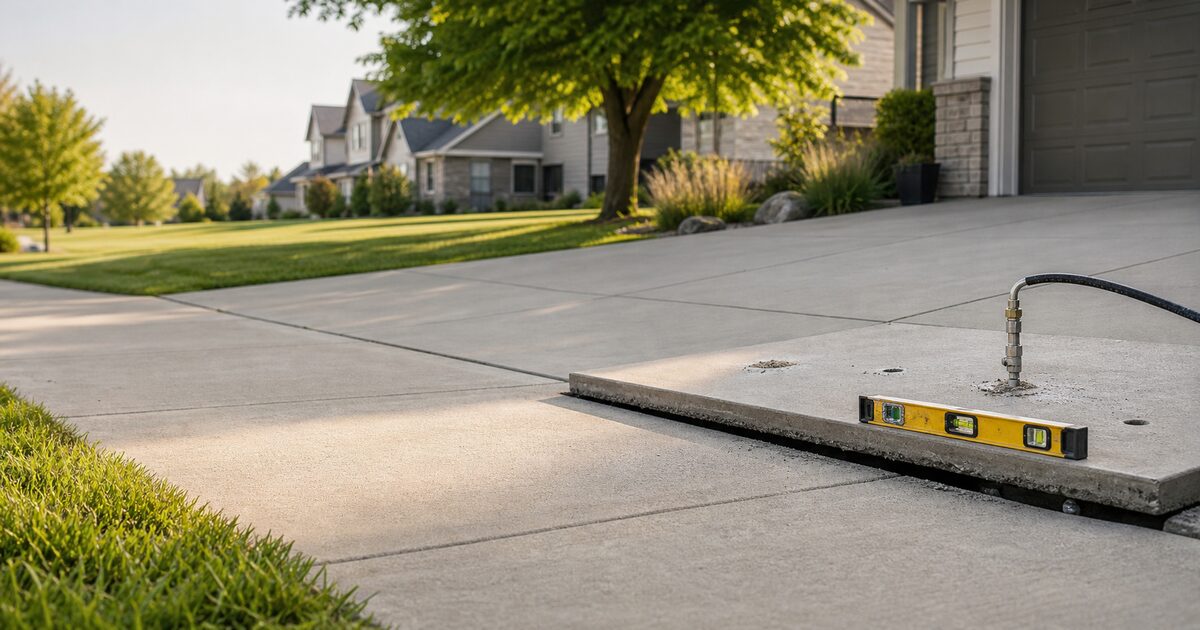
Is your sunken concrete serious?
A settled slab can be a nuisance, a trip hazard, a drainage problem, or a sign that the base below the concrete needs attention. This guide helps you sort what you can see before requesting a quote.
- Trip hazards
- Drainage
- Step gaps
- Garage lips
Prefer to call? (402) 347-7788
Start With What Changed
The most useful clue is not that the concrete has a crack. It is what changed: height, slope, water flow, safety, or the gap between the slab and the home.
- A sidewalk edge now catches a shoe, stroller, walker, or snow shovel.
- A driveway panel dropped near the garage and leaves a hard bump.
- Water now runs toward the house, garage, step, or foundation.
- A patio or step has opened a visible gap at the home.
- The slab keeps moving after each winter or heavy rain.
Triage The Problem
Use this as a practical first pass. It is not a structural inspection, but it helps you decide what kind of help to ask for.
| What you see | What it may mean | Practical next step |
|---|---|---|
| Small crack with no height change | May be cosmetic or normal shrinkage. | Monitor it, keep water out of the joint, and photograph it if it grows. |
| Raised sidewalk edge or driveway lip | Trip hazard or snow-removal problem. | Request a leveling quote and include a measurement photo. |
| Water draining toward the home | Settlement may be changing drainage around the structure. | Request review soon and include photos after rain if possible. |
| Crumbling, heaved, or badly broken slab | The concrete itself may be failing, not just settled. | Ask whether replacement is more appropriate than lifting. |
| Basement water, wall movement, or large structural cracks nearby | The slab may be only one symptom of a broader issue. | Ask a qualified professional to review the larger condition before treating it as simple leveling. |
Leveling May Fit When
Concrete leveling is most likely to make sense when the slab is still a usable piece of concrete but no longer sits where it should.
- The slab is mostly intact.
- The problem is settlement rather than heaving.
- There is access for hoses and equipment.
- The lift can improve a trip hazard, garage transition, patio slope, or drainage path.
- The underlying cause can be managed well enough for the repair to hold.
Get A More Careful Review When
Some conditions need more than a quick slab-lifting quote. When the problem touches drainage, safety, or the structure, ask more questions before choosing a repair path.
- Water is entering the basement or collecting against the foundation.
- Steps, porches, or slabs attached to the home are pulling away.
- The concrete is broken into many loose pieces.
- The slab has lifted upward, not just settled downward.
- Soil is visibly washing out below or beside the slab.
- A retaining wall, foundation wall, or nearby masonry is moving.
Next Guides
A good quote request shows the problem clearly and asks the right questions before anyone schedules work.
A four-photo guide that helps a contractor understand the slab before an estimate.
Questions to ask a contractorAsk about method fit, drainage, minimum charges, access, cleanup, and what is not included.
When leveling is not enoughKnow the red flags that may point toward replacement, drainage work, or another professional review.
Frequently asked questions
What areas around Omaha can use the quote request form?
The form is set up for Omaha, Council Bluffs, Blair, Glenwood, Springfield, and nearby communities. If your city is not listed, choose Other nearby city and include the city and ZIP code in the project details.
Why does the city matter for concrete leveling?
Location helps contractors think about travel, access, soil and drainage patterns, and whether they regularly serve that side of the metro. It also helps route the request to someone who is more likely to follow up.
Should I use a city page or a surface guide first?
Use the city page if local drainage, hills, or travel access seem important. Use the surface guide if the main question is about a driveway, sidewalk, patio, garage slab, step, or porch.
How Omaha Slab Repair works
We are a transparent quote-connection guide, not a concrete contractor. Homeowners submit details (surface, location, photos, drainage notes) so available local or regional leveling contractors can respond with useful next steps. We do not perform repairs or guarantee outcomes.
This model keeps the information neutral and helps you get better quotes by sending contractors the details they actually need.
Ready for contractor quotes? Use the form above. The details you send help us route your request to available local leveling teams.