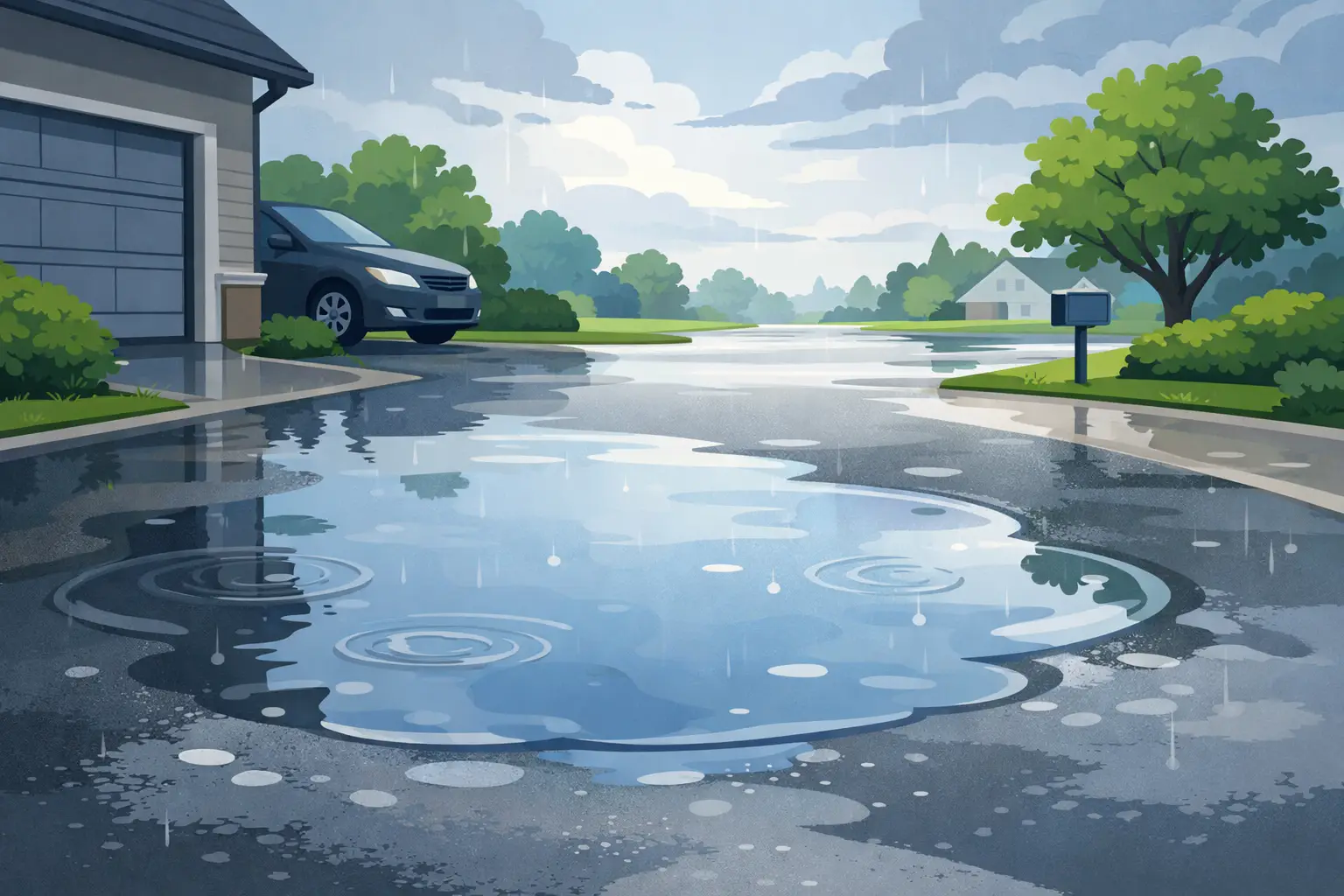
If you keep seeing water pooling on driveway after rain in the same spot, that puddle is usually telling you something useful. It may be as simple as a low area in the slab, or it may point to settlement, poor grading, runoff from a roofline, or a drainage pattern that is slowly making the concrete worse. For Omaha-area homeowners, this matters because freeze-thaw cycles can turn a shallow puddle into scaling, cracking, and more noticeable slab movement over time.
Why water collects on a driveway
A driveway should move water away from the garage, foundation, and main walking path. When it does not, there is usually a slope problem, a surface depression, or too much water being concentrated in one place.
Sometimes the issue starts in the concrete itself. A section of slab may have settled slightly, creating a bowl where rainwater sits. In other cases, the concrete may be mostly intact, but the surrounding grade sends too much water across the surface. Downspouts that discharge near the driveway, a yard that drains toward the slab, or a garage apron that no longer matches the rest of the drive can all contribute.
Age also matters. Older driveways often develop a mix of minor settlement, joint separation, and surface wear. One low panel might hold water for years before the problem becomes obvious enough to notice from the street.
Water pooling on driveway after rain: what it usually means
The most common explanation is a low spot. Concrete does not need to sink much before water starts collecting. Even a small dip can leave standing water long after the rest of the driveway dries.
That said, not every puddle means the slab needs to be lifted. It depends on where the water sits, how deep it gets, how long it remains, and whether there are signs of movement nearby. If water is ponding near the garage door, flowing toward the house, or collecting where slabs have dropped at the joints, the issue is more likely tied to settlement or poor pitch. If the driveway is flat overall but gets heavy roof runoff in one area, drainage correction may matter as much as slab repair.
This is where homeowners often get stuck. The symptom is obvious, but the cause is not always obvious from one puddle alone.
When pooling is more than a cosmetic issue
A shallow puddle in the middle of a driveway is not the same as water collecting against the garage slab or foundation-facing edge. Location changes the urgency.
Water that sits near the home can increase moisture around the structure, wash fines out from beneath slabs, and contribute to repeated freeze-thaw stress. In winter, that same spot can become an ice patch exactly where people step out of a vehicle. If the pooling area overlaps with a settled joint or visible crack, water infiltration can also worsen the void beneath the concrete.
In practical terms, the biggest concerns are usually these: water draining toward the garage, recurring puddles over a sunken slab section, erosion near slab edges, and signs that one panel has dropped lower than the next. Those conditions often justify a closer look sooner rather than later.
How to tell whether the driveway has settled
Start simple. After a rain, look at the outline of the puddle and the edges of the slab around it. If the water consistently forms in the same footprint, that usually indicates a fixed low area rather than random runoff.
Next, check the joints. A settled slab often shows height differences where one section meets another. You may also notice wider gaps, slight separation near the garage apron, or cracks that track across a low panel. If one part of the driveway feels uneven when you walk it or scrape a shovel across it, settlement becomes more likely.
A basic level or even a straight board can help you see whether the concrete has dipped. The goal is not to diagnose it like an engineer. It is to gather enough detail to understand whether you are looking at a drainage-only issue, a concrete elevation issue, or both.
Common causes in Omaha-area driveways
Local soil and weather patterns matter. In and around Omaha, driveways deal with seasonal moisture swings, freeze-thaw movement, and runoff conditions that can shift support under exterior slabs over time.
One common issue is water getting below the slab from the edges or joints. As supporting soil softens, washes out, or settles, the concrete may drop in isolated sections. Another is concentrated roof drainage. If a downspout empties near the driveway or between the drive and the house, repeated saturation can affect both drainage and slab support.
Poor original pitch is another possibility. Some driveways were never sloped quite right to begin with. Others were acceptable when installed but became functionally flat after years of minor movement. Tree roots, adjacent landscaping, and heavy vehicle loading can also play a role, although they are not the main cause in every case.
Repair options depend on the actual cause
If the puddle is caused by a sunken slab panel, concrete leveling may help restore drainage by raising the low section. Mudjacking or foam lifting can be a good fit when the slab is still structurally serviceable and the main problem is lost support or settlement.
If the concrete is badly cracked, broken into multiple unstable pieces, or has widespread surface deterioration, replacement may make more sense. Leveling works best when the slab can still be adjusted as a unit or in large stable sections. It is not a cure-all for every driveway problem.
Sometimes the slab can be lifted, but that alone will not solve the water issue. If runoff from a roofline keeps overloading the area, drainage changes may still be needed. That could mean extending downspouts, adjusting grade near the driveway edge, or addressing places where water is being trapped and redirected back onto the slab.
In other words, the right fix is often either leveling, drainage correction, or a combination of both. That is why a quote based only on the word puddle is rarely enough.
What contractors usually need to assess pooling
If you plan to request estimates, details matter. Contractors generally want to know where the water is pooling, whether the puddle is near the garage or street, how long it stays after rainfall, and whether the concrete is visibly sunken or cracked.
Photos help most when they show the whole driveway and the specific low spot. A wide shot can reveal slope and drainage patterns. A close shot can show joint offsets, cracks, edge gaps, and standing water depth. It also helps to note whether downspouts discharge nearby and whether the puddle has gotten worse over time.
This is where a quote-connection service like Omaha Slab Repair can be useful. The goal is not to diagnose the project from a website form alone. It is to organize the project details local contractors need so the next conversation is more specific and less guesswork.
When not to wait
Some driveway puddles can be watched for a while. Others are worth addressing promptly.
If water is backing toward the garage, entering control joints, freezing into a regular slip hazard, or appearing alongside slab separation and settlement, waiting usually does not improve the outcome. The same goes for pooling that seems tied to erosion at the slab edge or repeated washout after storms.
By contrast, a very minor shallow spot in an otherwise stable driveway may be something a homeowner monitors first, especially if there are no trip hazards, no drainage toward the house, and no signs of active sinking. The key is being honest about whether it is staying the same or slowly getting worse.
A practical next step for homeowners
The most useful first move is to document the problem before the water disappears. Take photos after a normal rain, note where runoff is coming from, and look for nearby slab height changes. That gives you a much better starting point than describing it later from memory.
From there, think in terms of function, not just appearance. Is the water harmlessly sitting for an hour in a shallow low spot, or is it collecting against the garage, feeding ice, and pointing to a settled section of concrete? That answer usually tells you whether you are dealing with a nuisance or a repair decision.
A driveway should not act like a catch basin. If the same puddle keeps returning, it is worth finding out whether the real fix is lifting the slab, correcting drainage, or deciding that a more extensive replacement is the better long-term call.