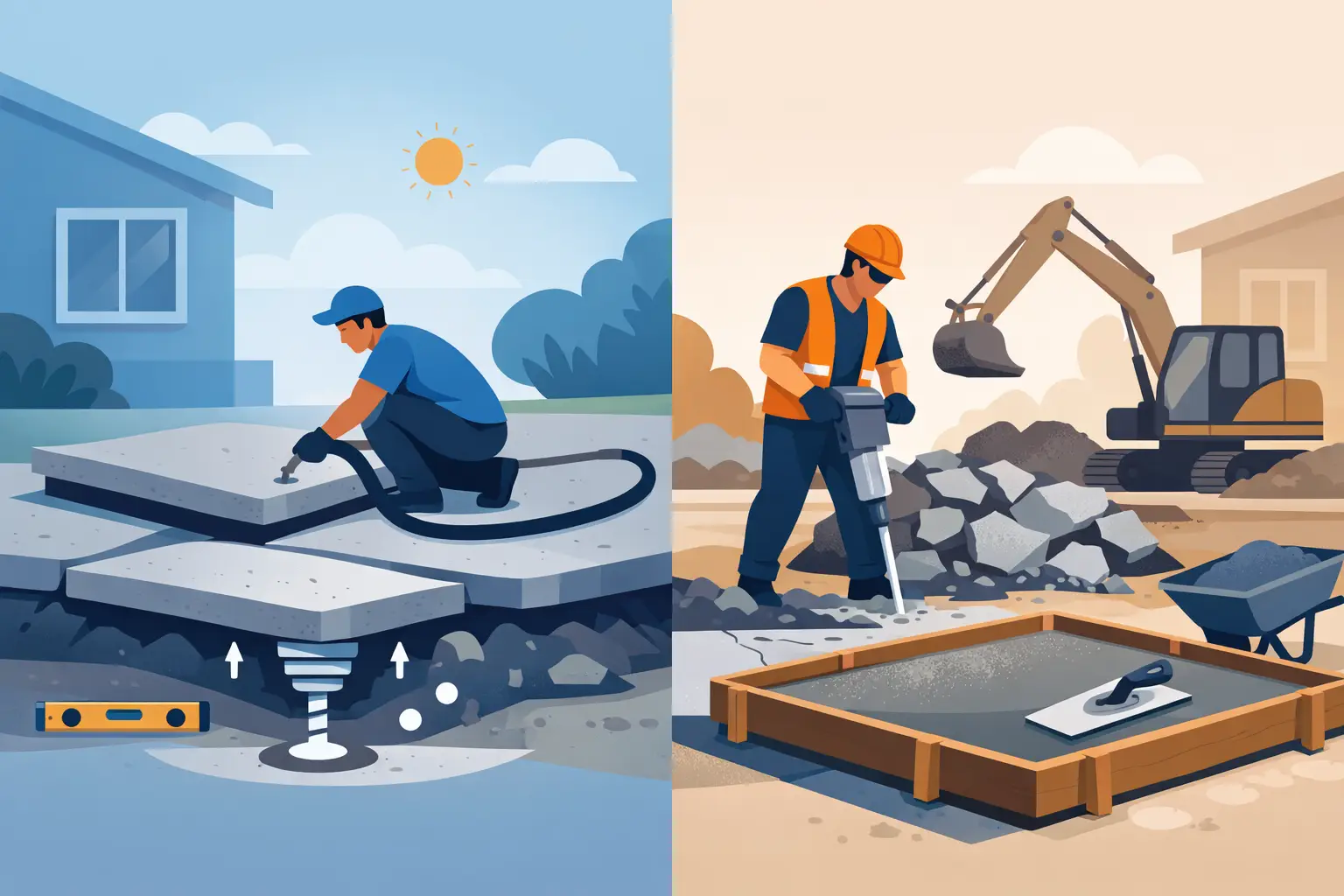
A driveway panel drops an inch, the sidewalk starts catching toes, or the patio begins sloping water back toward the house. That is usually when homeowners start comparing concrete leveling vs replacement. The right answer depends less on the surface itself and more on why it moved, how badly it moved, and whether the slab is still solid enough to save.
For many Omaha-area homes, leveling is the faster and less disruptive option. But not every settled slab should be lifted. Some need to be removed and poured again, and some need drainage or soil correction addressed before either option will hold up. If you are trying to decide what makes sense for your driveway, sidewalk, garage slab, porch, or patio, it helps to look at the slab condition first and the repair method second.
Concrete leveling vs replacement: the basic difference
Concrete leveling raises an existing slab that has settled. Contractors usually do this by injecting material beneath the concrete to fill voids and lift it back toward its original position. Depending on the contractor and project, that may involve mudjacking or polyurethane foam lifting.
Replacement means the old slab is broken out, removed, the base is rebuilt as needed, and new concrete is poured. That takes longer, costs more in most cases, and creates more disruption around the home. It also gives a contractor the chance to start over if the slab is too damaged to salvage.
This is why the decision is not really about old versus new. It is about whether the existing concrete still has enough integrity to be worth lifting.
When concrete leveling usually makes sense
Leveling tends to work best when the slab is intact but no longer sitting where it should. A common example is a sidewalk section that has dropped from soil settlement while the concrete itself remains mostly solid. The same goes for many patios, stoops, garage floors, and driveway panels where one section settled lower than the next.
If the slab has minor cracking, a manageable amount of separation, and no major surface breakdown, lifting can often correct the height difference without tearing everything out. It also helps when the main complaint is practical rather than structural, such as a trip hazard, poor drainage, or water pooling near the garage.
In those situations, leveling can preserve usable concrete and reduce downtime. Homeowners often prefer it because the area can usually return to service sooner than a full replacement project.
Good candidates for leveling
A slab is often a reasonable leveling candidate when the concrete is still in one piece, the settlement is moderate, and the cause appears localized rather than severe. That can include voids from washout, soil consolidation, or sections that sank over time near downspouts or poorly directed runoff.
Driveways and sidewalks are common examples, especially when the problem is unevenness between panels. Patios and porch slabs can also be good candidates if they have pulled away slightly or settled without major fragmentation.
Why leveling is often the first option homeowners ask about
The appeal is straightforward. It is usually less expensive than replacement, requires less demolition, and avoids the mess of removing and repouring an entire section that may still be structurally usable. For homeowners trying to fix a hazard or drainage issue without turning the yard into a work zone, that matters.
Still, lower cost alone is not a reason to choose it. A slab that is badly cracked, crumbling, or sitting on unstable conditions may not hold a lift well enough to justify the repair.
When replacement is the better call
Replacement becomes more likely when the slab is no longer worth saving. If the concrete is breaking apart, has widespread cracking through multiple directions, or shows serious spalling and edge failure, lifting may only raise damaged concrete instead of solving the underlying problem.
The same is true when movement is tied to a larger issue that a simple lift cannot correct. If there is persistent erosion, significant base failure, tree root displacement, frost-related heaving, or repeated water problems against the home, replacing the slab may be part of a broader fix. In some cases, the slab itself is not the only issue.
Garage floors and porch slabs deserve extra caution here. If there are signs of structural stress, wall movement, foundation concerns, or settlement patterns that extend beyond the slab, homeowners should not assume leveling is enough just because the surface is uneven.
Signs a slab may be too far gone to lift
A few cracks do not automatically mean replacement. Concrete cracks. What matters is the pattern and severity. If the slab is shattered into multiple loose sections, if one end has dropped dramatically, or if the surface is scaling and deteriorating badly, replacement is often the more realistic path.
Another red flag is prior failed repair. If the slab was patched, lifted, or otherwise addressed before and continued moving because water or soil issues remained, doing the same thing again may not be the best use of money.
Cost is part of the decision, but not the whole decision
Most homeowners start here, and that is understandable. Leveling is often cheaper than replacement because it avoids demolition, hauling, form work, new concrete, and curing time. But the lowest price is not always the lowest long-term cost.
If a slab can be lifted successfully and the cause of settlement is manageable, leveling may offer strong value. If the slab is badly deteriorated and likely to fail again, replacement may cost more upfront but make more sense over time.
This is also where accurate project details matter. Contractors will usually want to know the slab type, approximate size, amount of settlement, visible cracks, drainage patterns, access limitations, and whether photos show separation near the house, garage, or steps. Better information usually leads to better quote guidance.
The hidden factor in concrete leveling vs replacement: why the slab settled
Homeowners often focus on how uneven the concrete looks. Contractors usually focus on why it moved. That is the part that determines whether a repair has a good chance of lasting.
In Omaha and nearby communities, settlement can come from soil movement, poor compaction, erosion from downspouts, runoff washing out support beneath slabs, or repeated moisture changes around the home. If those conditions are still active, lifting or replacement alone may not be enough.
For example, a patio that settled because water drains toward the back of the house might be liftable. But if the drainage pattern stays the same, the problem can return. A driveway panel near the garage may also need runoff control, joint sealing, or grading improvements, not just height correction.
That is why a trustworthy recommendation often sounds less dramatic than homeowners expect. Sometimes the answer is level it. Sometimes it is replace it. Sometimes it is fix the water issue first, then decide.
Surface-by-surface differences homeowners should know
Sidewalks are often strong candidates for leveling because the issue is commonly isolated settlement between panels. The goal is usually to remove a trip hazard and restore a smoother walking surface.
Driveways can also respond well to leveling, especially when one slab section dropped and the surrounding concrete is still in fair shape. But heavy vehicle loads, broken edges, and widespread cracking can tip the decision toward replacement.
Patios and porch slabs depend heavily on drainage and separation. If the slab settled away from the house but remains intact, lifting may help. If it is severely cracked or contributing to water intrusion, replacement or additional drainage work may be needed.
Garage slabs vary more. Some can be lifted successfully. Others show settlement that overlaps with foundation, apron, or entry transition issues. That usually calls for a more careful review before choosing a method.
How to prepare before asking for quotes
If you are gathering estimates, the most useful thing you can do is document the problem clearly. Note where the slab is located, how much it appears to have dropped, where water goes during rain, and whether there are visible voids, cracks, or access limitations. Photos from multiple angles help, especially near the low point and any area where the slab meets the house, garage, or steps.
That is the practical value of a quote-request resource like Omaha Slab Repair. It helps organize those details so contractors can respond with more informed next steps instead of guessing from a short description.
The goal is not to push every homeowner toward leveling. It is to help narrow the decision before you spend time chasing the wrong kind of estimate.
If your slab is mostly intact and the main issue is settlement, leveling may be the smarter move. If the concrete is failing or the underlying conditions are bigger than the slab itself, replacement may be the better investment. The clearest path usually starts with one honest question: is this concrete still worth saving?