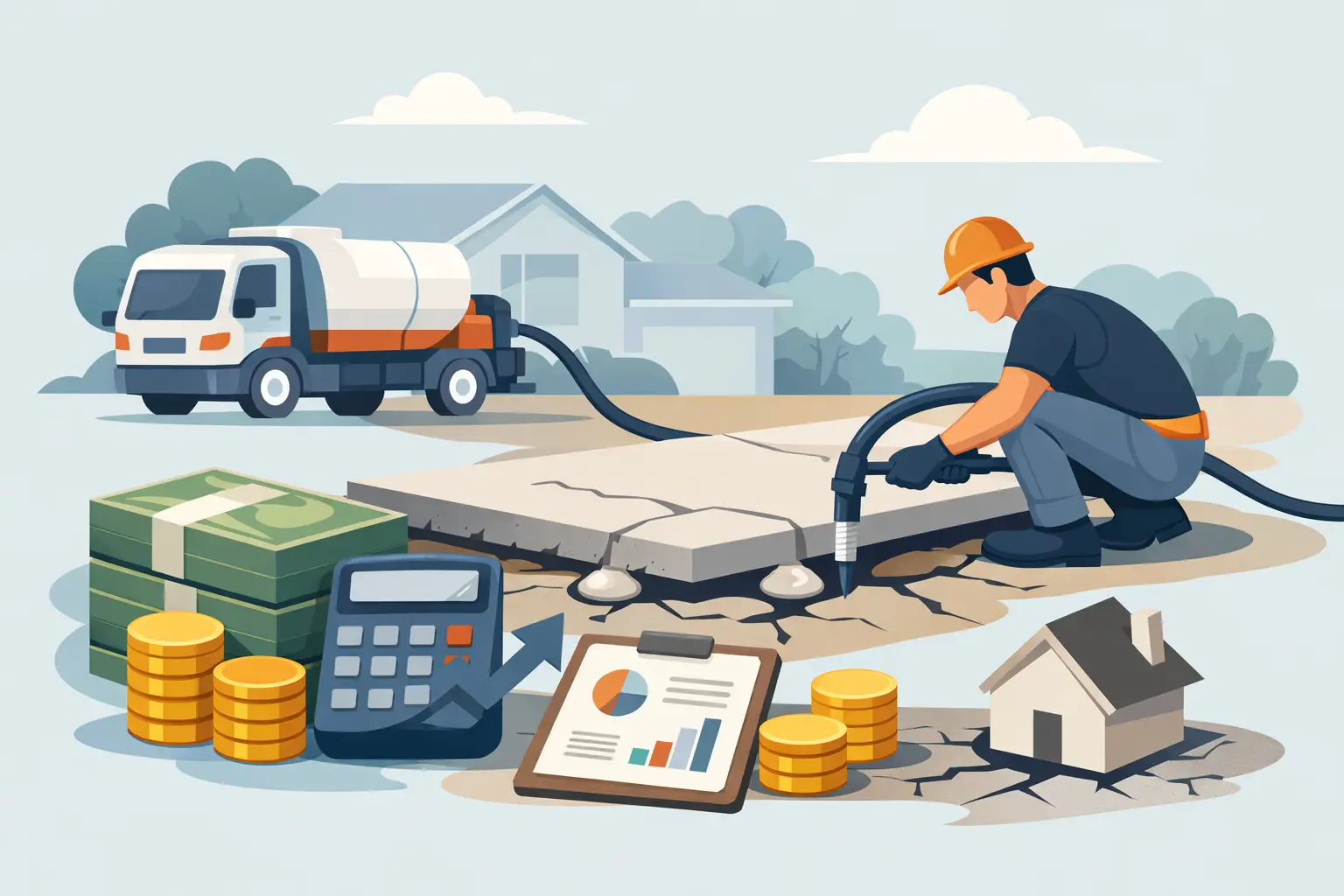
A driveway panel drops an inch, the patio starts holding water, or the walk to your front door turns into a trip hazard. That is usually when homeowners start asking how much does mudjacking cost, and the honest answer is that the price can vary quite a bit based on the slab, the cause of settlement, and how easy the area is to access.
For most residential projects, mudjacking is usually priced well below full concrete replacement. Small repairs may fall in the few-hundred-dollar range, while larger or more complex jobs can move into the low thousands. If you are dealing with a settled sidewalk section, one porch slab, a short run of steps, or part of a patio, the cost profile is very different from a wide driveway apron or a garage slab with heavier load demands.
How much does mudjacking cost for most homes?
In practical terms, many homeowners will see mudjacking quotes land somewhere around $500 to $2,500 for common residential work. Some very small jobs may come in below that, and some larger jobs can exceed it, but that range covers a lot of the typical projects people ask about in the Omaha area.
A single sunken sidewalk panel or one small stoop section may be on the lower end if access is easy and the slab is still in decent condition. A larger patio, multiple settled sections, or a driveway with broader settlement can cost more because the contractor may need more material, more drill points, and more time to achieve a stable lift.
That is one reason price-per-square-foot estimates can be misleading on their own. Mudjacking is not just about surface area. It is also about voids under the slab, depth of settlement, pumping time, material volume, and whether the slab can be raised safely without cracking.
What changes the cost of mudjacking?
The biggest cost driver is usually the slab itself. A plain sidewalk panel is simpler than a driveway section that supports vehicles. A lightly settled patio can be straightforward, while a garage floor near the overhead door may require more careful evaluation because slope, drainage, and edge support matter more there.
Settlement severity also matters. If the slab is only slightly uneven and still largely supported, lifting it may take less effort and material. If there are larger voids underneath, visible washout, or more dramatic sinking, the repair can become more labor-intensive. Contractors are not just lifting concrete. They are trying to fill the empty space below it and restore support.
Access is another common pricing factor that homeowners do not always think about. If equipment can be brought in easily and the crew has room to work, that helps. If the slab sits behind a fence, next to landscaping, or in a tight side yard, labor and setup can increase.
Drainage conditions can also change the number. If downspouts discharge near the slab, soil erosion is visible, or water runs back toward the house, a contractor may still quote the leveling work, but they may also note that the drainage issue should be corrected. Otherwise, the slab can settle again. That does not always raise the mudjacking price directly, but it changes the overall repair picture.
Typical mudjacking costs by project type
Sidewalks and walkways are often among the more affordable mudjacking projects because the slabs are smaller and easier to isolate. If only one or two panels are affected, the job may stay on the lower end of the range. The exception is when the settlement is part of a broader drainage or soil movement problem.
Patios usually fall into the middle range. A small patio with one low corner may be fairly simple. A larger backyard slab with multiple settled areas, poor runoff, or separation near the house often takes more planning. If the patio has cracked heavily or broken into unstable sections, replacement may be the better path.
Driveways tend to cost more than sidewalks and small patios. They are larger, thicker in many cases, and expected to handle vehicle weight. If the sinking is near the garage entrance or apron, the work may need tighter slope control to avoid water intrusion and tire impact issues.
Garage slabs can also be more complex than they first appear. If the interior slab has settled but the perimeter foundation remains in place, leveling might be possible. If there are signs of deeper structural movement, wide cracks, or settlement tied to foundation issues, a contractor may recommend broader evaluation before any lifting work.
Steps and porch-related slabs are often job-specific. One settled step pad may be a modest repair. A porch slab tied into columns, masonry, or adjacent finishes is more sensitive. In those cases, lifting may still be an option, but caution matters more than speed.
Mudjacking vs replacement on price
If your concrete is still mostly intact, mudjacking is often cheaper than tearing out and replacing the slab. Replacement adds demolition, haul-away, new base preparation, forming, pouring, finishing, and curing time. It also usually creates a longer disruption around the home.
That does not mean mudjacking is always the right answer. If the concrete is badly cracked, crumbling, heaved, or too thin to respond well to lifting, replacement may be the more sensible investment. The lower upfront price of leveling only helps if the slab is a good candidate.
This is where homeowners can save time by gathering useful project details before requesting quotes. Photos, slab type, where water collects, how much the surface has dropped, and whether nearby downspouts or grading may be involved all help contractors give more accurate next steps.
Why one quote can be much higher than another
When homeowners compare estimates, they are often not comparing identical scopes. One contractor may be quoting the lift only. Another may be pricing a more difficult stabilization scenario with greater material use. A third may believe the slab is not a strong candidate for mudjacking at all and may price conservatively because of the risk.
Method differences matter too. Some companies focus on traditional mudjacking, while others recommend polyurethane foam lifting. Foam can cost more in many cases, but it has different performance characteristics and may be preferred for certain applications. The right method depends on the slab, weight load, access, moisture conditions, and the amount of lift needed.
That is why the cheapest number is not always the best number. A quote should make sense in context. What surface is being lifted, how much settlement is present, what caused it, and what limitations does the contractor see? Those details are more useful than a price alone.
How to get a more accurate mudjacking estimate
If you want a better answer to how much does mudjacking cost for your property, the quality of the project information matters. Contractors typically need to know what type of slab is affected, roughly how many sections are involved, whether the problem is at a driveway, sidewalk, patio, garage, or porch, and how severe the settlement appears.
Photos help a lot, especially when they show the full area and close-ups of cracks, gaps, pooling water, or slab separation. It also helps to mention whether the slab is near the house, whether there are drainage issues, and whether access is restricted by fencing, gates, or landscaping.
For homeowners in Omaha and nearby communities, that kind of organized quote request usually leads to more useful responses than a short message that only says the concrete is sinking. Omaha Slab Repair is set up around that exact idea - helping homeowners organize the project details contractors usually need before pricing slab leveling work.
When mudjacking may not be worth the cost
Sometimes the better question is not how much mudjacking costs, but whether paying for it makes sense for that slab. If the concrete has major structural cracking, severe edge breakdown, repeated past repairs, or active water problems that have not been fixed, leveling may only be a partial answer.
The same goes for slabs that have settled because of larger site issues. If runoff, gutter discharge, poor grading, or chronic soil washout are still in play, the slab can move again after lifting. A good quote should acknowledge that. Homeowners deserve to know when drainage correction or replacement belongs in the conversation.
Pay attention to the condition of the concrete itself, not just the height difference. A slab that is low but otherwise solid is often a better mudjacking candidate than a slab that is only slightly uneven but heavily cracked and deteriorated.
Mudjacking can be a cost-effective repair, but it is not a one-price service and it is not the right fit for every slab. The most useful next step is to look at the actual surface, document the drainage and settlement conditions, and get a quote based on the real job rather than a generic average.