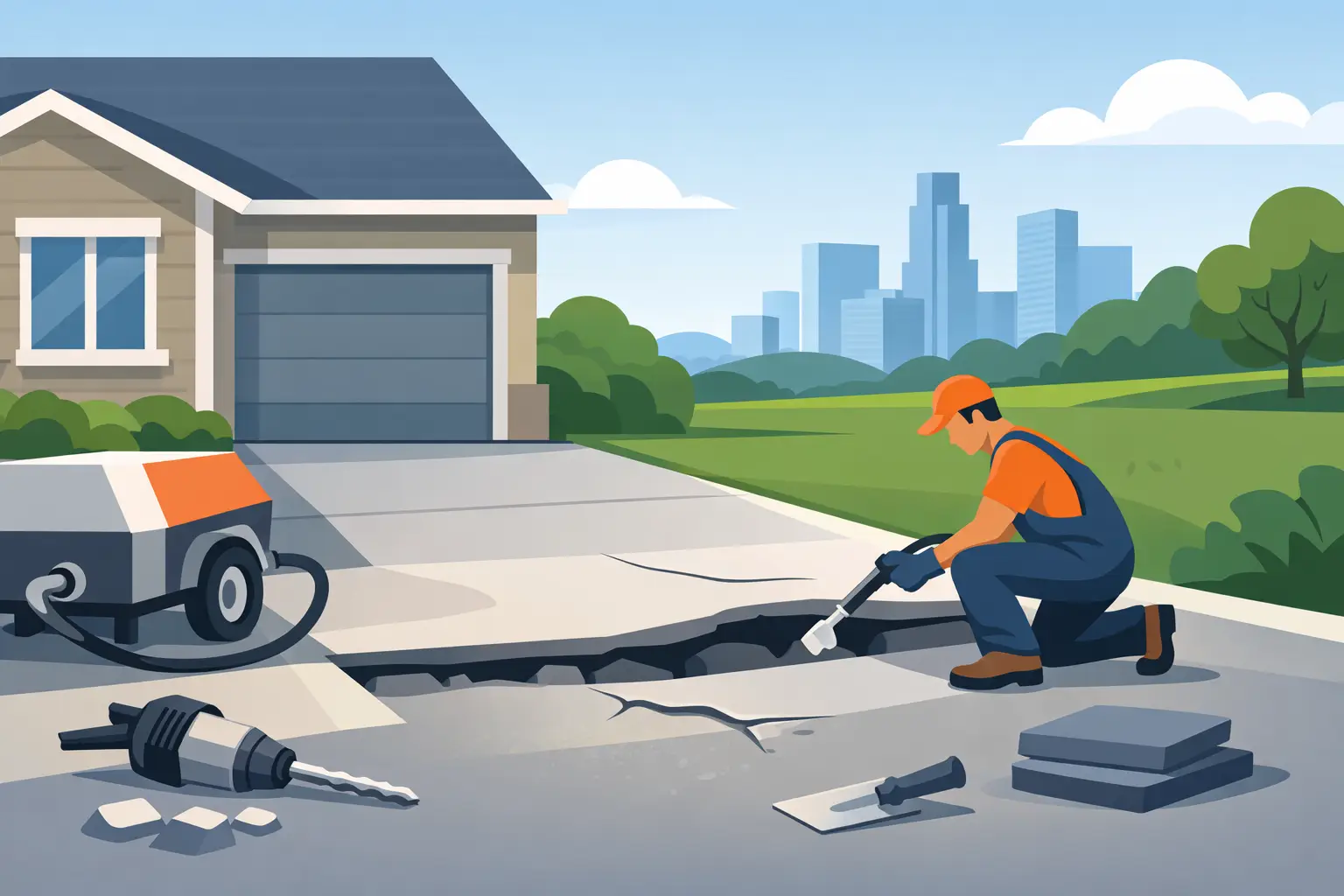
A driveway usually tells on itself before it fully becomes a problem. In Omaha, that often starts with a slight dip near the garage, water sitting after a storm, or one slab edge rising just enough to catch a tire or a snow shovel. Sunken driveway repair Omaha homeowners look into is rarely just about appearance. It is usually about drainage, access, safety, and figuring out whether the slab can be lifted or needs something more involved.
For most residential driveways, the real question is not whether the concrete moved. It is why it moved, how far it moved, and whether leveling still makes sense. That is where a lot of homeowners get stuck. You can see the settlement, but you may not know if mudjacking, foam lifting, partial replacement, or drainage correction is the right next step.
When sunken driveway repair in Omaha is the right fix
A sunken driveway is often repairable when the slab is still generally intact. If the concrete has settled but is not badly shattered, lifting methods may restore height and improve slope without tearing out the whole section. This is common when soil under the slab has compacted unevenly, washed out near downspouts, or shifted through repeated freeze-thaw cycles.
Driveways near garage doors are a frequent trouble spot. Water may run back toward the garage instead of away from it, or the slab may drop enough to leave a noticeable lip. In those cases, leveling can sometimes correct both the height difference and the drainage pattern. The key word is sometimes. If the slab is cracked in multiple directions, broken into unstable pieces, or has underlying subgrade issues that were never addressed, lifting alone may not hold up the way you want.
Omaha-area soil conditions also matter. Expansive clay, seasonal moisture swings, and runoff issues can all contribute to settlement. A repair method that looks cheaper upfront may not be the better value if the water problem remains in place.
What contractors look at before quoting driveway settlement
Homeowners often want a price first, but the condition details usually decide whether that price means anything. A useful quote starts with the slab layout, how far it has settled, and whether there are visible cracks, spalling, or separation at joints. Contractors also want to know where the low area sits in relation to the garage, street, sidewalk, or retaining edges.
Drainage is one of the biggest factors. If water from a downspout empties near the driveway, if the grade pushes runoff across the slab, or if the settled section regularly holds water, that affects both the likely cause and the repair plan. Access matters too. A straightforward front driveway with open working space is different from a narrow side approach, a shared edge, or an area blocked by landscaping or fences.
Photos help more than most homeowners expect. A wide shot shows layout and slope. Close-ups show crack patterns, joint gaps, and the severity of settlement. If you are requesting quotes through a referral or information service, those details make it easier for local contractors to give more realistic next steps instead of guessing.
Mudjacking vs. foam lifting for sunken driveway repair Omaha projects
Both methods are used to raise settled concrete, but they are not interchangeable in every case. Mudjacking pumps a slurry beneath the slab to fill voids and lift it. Foam lifting uses expanding polyurethane foam for a similar result with different material behavior and installation characteristics.
Mudjacking has been around longer and can be a solid fit for many residential driveway slabs. It is often considered when homeowners want a proven leveling method and the slab condition supports it. Foam lifting is lighter, cures quickly, and may be preferred where precision and reduced added weight matter more.
That does not mean one method is always better. It depends on slab thickness, soil condition, access, void size, moisture exposure, and the amount of lift needed. It also depends on contractor preference and what they see on site. A neutral quote process is helpful here because it keeps the focus on method fit rather than pushing a one-size-fits-all answer.
When driveway leveling may not be enough
Not every sunken driveway should be lifted. If a section is heaved in one area and sunken in another, the issue may be tied to broader soil movement or drainage failure. If the concrete is badly deteriorated, scaling apart, or broken into several loose panels, replacement may be the cleaner long-term solution.
Sometimes only part of the driveway needs replacement while another section can still be leveled. That is a practical middle ground many homeowners overlook. For example, a garage apron with major cracking may need to come out, while the adjacent slab farther down the drive might still respond well to lifting.
There are also cases where drainage correction should happen alongside repair. Extending downspouts, adjusting grade, or dealing with runoff near the house may be just as important as raising the slab. Without that, the driveway can settle again, even if the lifting work itself was done correctly.
Cost factors homeowners should expect
There is no reliable flat price for a settled driveway without knowing the layout and severity. The cost depends on how many slabs are involved, how far they dropped, what method is being used, and whether there are voids, washout, or difficult access conditions. A small lift near one panel joint is very different from a multi-slab correction near a garage with drainage concerns.
Driveway thickness and reinforcement can also affect the approach. So can the need to stabilize a larger hollow area beneath the slab. If replacement enters the conversation, then disposal, forming, base prep, and cure time shift the cost picture entirely.
That is why generic online price ranges can be misleading. They leave out the details that actually move the estimate. Better quote requests usually include city, slab type, visible settlement, drainage notes, photos, and whether the area is causing standing water or garage entry issues.
How to prepare for a quote request without wasting time
The fastest way to get useful feedback is to gather the basic job facts before you start contacting anyone. Measure the general area if you can, even if it is only approximate. Note where the lowest point sits and whether water drains toward the house, garage, or public walk. Check whether the slab has one clean crack, multiple intersecting cracks, or obvious separation from nearby concrete.
It also helps to describe the history. Did the settlement appear gradually over several years, or did it become obvious after heavy rain, gutter problems, or winter freeze-thaw damage? Has anyone repaired it before? Those details give contractors context that can change the recommendation.
This is where a service like Omaha Slab Repair can be useful. It does not perform the repair work or act as a contractor. Its role is to help homeowners organize the project information local contractors usually need so the quote process starts on firmer ground.
Signs your driveway issue is more than cosmetic
A driveway dip is easy to ignore until it starts affecting how the property functions. If water is ponding against the garage, if one slab edge creates a trip point, or if vehicle clearance is becoming an issue, the problem has moved beyond looks. The same goes for settlement that appears to be pulling nearby sidewalk sections or front steps out of alignment.
Watch for widening joints, repeated water accumulation, or erosion along slab edges. Those are signs the supporting soil may be changing, not just the concrete surface. In those cases, it makes sense to get the condition reviewed sooner rather than later. Small settlement is usually easier to address before it turns into a bigger replacement decision.
Why local context matters in Omaha
Driveway settlement in Omaha is not unusual, but the cause can vary from one property to the next. Older neighborhoods may have aging flatwork and long-term soil movement. Newer areas can still experience compaction problems, runoff concentration, or poor drainage around drive approaches. Council Bluffs, Blair, Glenwood, and Springfield can present similar issues, but site layout and moisture patterns still make each job a little different.
That is why method selection should be tied to your actual slab condition, not just a general preference for lifting or replacement. Homeowners usually get better results when they slow down long enough to document the problem clearly and ask the right questions before choosing a repair path.
If your driveway has started sinking, the most helpful next step is usually not guessing the method. It is getting the condition defined well enough that a contractor can tell you what is realistic, what is not, and what needs to happen first.