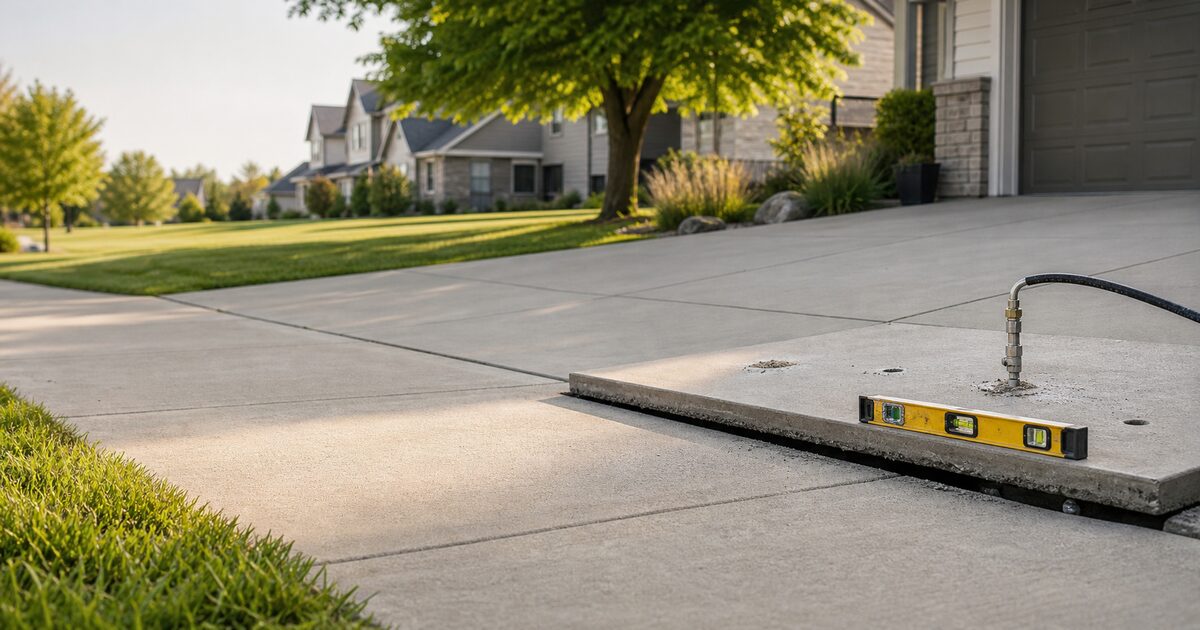
Patio concrete leveling starts with water and slope.
A settled patio can pull away from steps, hold water, slope toward the home, or create an uneven outdoor living surface. The right repair conversation starts with where the water goes and whether the slab is still sound.
- Patios
- Water slope
- Door gaps
- Outdoor slabs
Prefer to call? (402) 347-7788
What You May Be Seeing
Patio settlement often becomes obvious after rain or near a door, step, or foundation wall.
- The patio slopes toward the house instead of away from it.
- Water pools in a low area after rain.
- A gap has opened near a step, door threshold, or foundation.
- The slab rocks, feels uneven, or has dropped at one corner.
- Outdoor furniture or walking paths no longer sit level.
When Leveling May Fit
Leveling may be practical when the patio settled downward, the concrete remains mostly intact, and the contractor can improve the slab position without creating a new drainage issue.
- The low area can be raised to improve the slope.
- The patio panels are not severely broken or crumbling.
- Equipment access is possible through a gate, side yard, or driveway.
- Nearby steps, doors, and walkways can be reviewed together.
- Joint sealing, drainage, or grading questions can be discussed before repair.
When Replacement Or Drainage May Come First
A patio near the home deserves extra attention because water can affect more than the concrete surface.
| Condition | Why it matters |
|---|---|
| Water runs toward the home | Leveling may help the slab position, but drainage or grading may still need attention. |
| Water enters a basement or doorway | The water problem should be reviewed before treating the patio as only a lifting job. |
| Patio is tied to steps or a stoop | Connected entry slabs can change how much movement is practical. |
| Surface is badly spalled or broken | A weak slab may not be a good lifting candidate. |
| Retaining wall or soil movement nearby | Movement around the patio may point to a broader site issue. |
Photos And Measurements To Send
Patio photos should show the slab, the house, the water path, and any tight access areas.
- A wide photo showing the patio and the nearest door, step, or foundation wall.
- A close photo of any gap, low corner, crack, or settled edge.
- A photo after rain if water pools or moves toward the home.
- A ruler, level, or tape measure if the slope or drop is visible.
- Photos of gate width, side-yard access, landscaping, or obstacles.
A four-photo guide that helps a contractor understand the slab before an estimate.
Compare repair methodsCompare mudjacking, foam lifting, replacement, grinding, sealing, and drainage corrections.
Cost factorsSee why slab size, lift height, access, method, and add-on work can change a quote.
Request a quoteSend the surface, city, photos, measurements, drainage notes, and timing in one request.
Omaha-Area Quote Context
Patio, walkway, and outdoor slab requests should include city, access, water direction, and how the slab connects to the house.
For city driveways, garage approaches, sidewalk trip hazards, patios, steps, and drainage-sensitive slabs around Omaha.
Concrete leveling in Council Bluffs, IAFor river-influenced drainage, older neighborhoods, and settled slabs on the Iowa side of the Omaha metro.
Concrete leveling in Blair, NEFor longer drives, detached garages, sidewalks, acreage access, and freeze-thaw slab movement around Blair.
Concrete leveling in Glenwood, IAFor hillside drainage, patio slope, driveway settlement, garage approaches, and entry slabs around Glenwood.
Mudjacking in Springfield, NEFor Sarpy County corridor properties with mixed urban-rural settlement patterns between Omaha and Lincoln.
Frequently asked questions
Can a patio that slopes toward the house be leveled?
Sometimes. A contractor can review whether lifting can improve the slope, but water moving toward the home may also need grading, drainage, or joint sealing.
What patio conditions make replacement more likely?
Replacement is more likely when the patio is badly spalled, broken into loose pieces, tied to structural movement, or needs a completely new slope or layout.
What patio photos should I send?
Send a wide photo of the patio and nearby door or wall, closeups of gaps or low corners, a photo after rain if water pools, and access photos for gates or side yards.
How Omaha Slab Repair works
We are a transparent quote-connection guide, not a concrete contractor. Homeowners submit details (surface, location, photos, drainage notes) so available local or regional leveling contractors can respond with useful next steps. We do not perform repairs or guarantee outcomes.
This model keeps the information neutral and helps you get better quotes by sending contractors the details they actually need.
Ready for contractor quotes? Use the form above. The details you send help us route your request to available local leveling teams.