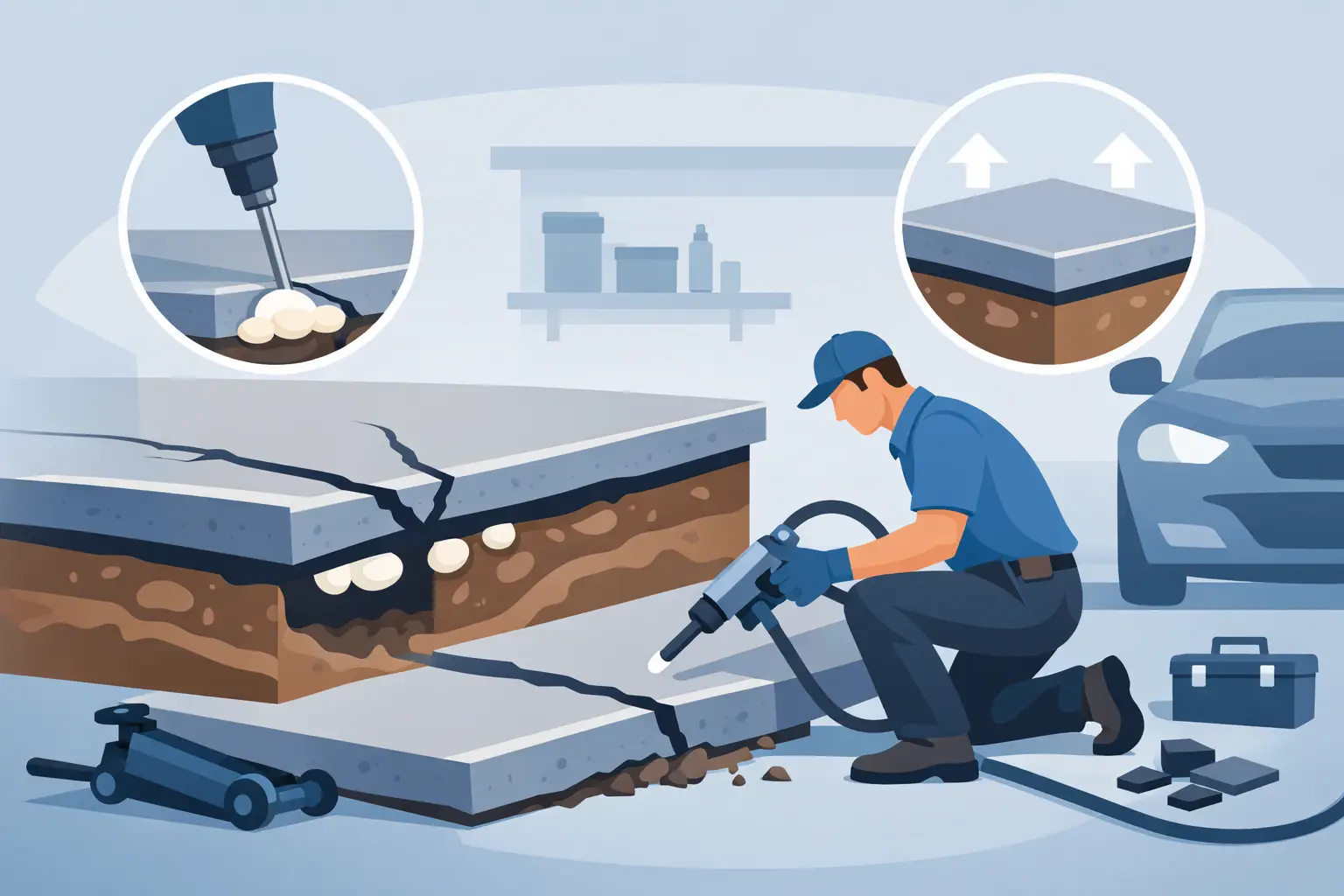
A garage slab rarely sinks all at once. More often, you first notice a hairline gap at the wall, a low corner that holds water after snow melt, or a floor that seems just a little off when you pull the car in. Garage floor sinking repair usually starts with those small signs, and the right next step depends on why the slab moved in the first place.
For homeowners around Omaha, that distinction matters. Some sunken garage floors can be lifted and stabilized without replacement. Others point to drainage issues, voids under the slab, or settlement serious enough that leveling alone will not solve the problem. Knowing the difference helps you ask better questions and get more useful quotes.
What causes a garage floor to sink?
Most garage slab settlement comes back to soil movement under the concrete. Fill soil may not have been compacted well when the home was built. Water may be washing fines away from under the slab. Downspouts may be dumping near the garage perimeter. In some cases, repeated freeze-thaw cycles and seasonal moisture changes gradually weaken support below one section of the floor.
The pattern of sinking often tells part of the story. If one front corner near the overhead door has dropped, runoff and edge erosion may be involved. If the slab is lower toward the middle, there may be a void under part of the floor. If the garage floor is sinking near the foundation wall, that deserves closer review because the issue may overlap with broader settlement or water management problems.
Not every uneven garage floor is a candidate for slab lifting. A badly cracked slab, a floor that has broken into unstable sections, or settlement tied to foundation movement may point toward replacement or a larger structural review instead.
Garage floor sinking repair options
There is no single repair that fits every garage. The best method depends on slab condition, access, amount of settlement, and what caused the movement.
Mudjacking and slab lifting
Traditional mudjacking lifts concrete by pumping a slurry under the slab to fill voids and raise the sunken area. It can work well when the slab is still largely intact and the goal is to restore support and improve elevation without tearing the floor out.
This approach is often considered when homeowners want a more cost-conscious alternative to replacement. It is also useful when the garage slab has settled but still has enough structural integrity to be lifted in a controlled way. The trade-off is that not every slab can be brought perfectly level, especially if the concrete is heavily cracked or settlement is uneven across multiple sections.
Polyurethane foam lifting
Foam lifting uses expanding polyurethane injected through small holes to raise and support the slab. Contractors may recommend it when more precise lifting is needed or when a lighter material is preferred under the concrete.
Foam can be a good fit for certain garage floors, but it is still only as effective as the surrounding conditions allow. If water is continuing to undermine the soil, even a successful lift may not last as expected unless drainage issues are addressed too.
Partial replacement or full replacement
If the slab has major deterioration, heaving and sinking in different areas, or deep cracking with movement, replacement may be the more realistic option. That is especially true when the concrete is no longer acting like one stable slab.
Replacement costs more and takes longer, but sometimes it avoids spending money on a lift that cannot deliver a durable result. A good quote process should make that distinction clear rather than pushing leveling in every case.
When leveling works well - and when it does not
Leveling tends to make the most sense when the garage slab is sunken but still in decent condition overall. A few cracks are not always a deal-breaker. Minor separation at joints, isolated low spots, and settlement caused by voids under otherwise solid concrete can often be addressed with lifting.
It becomes less straightforward when the slab is crumbling, the surface is badly scaled, the floor has dropped several inches, or there are signs of movement tied to the foundation or load-bearing walls. In those situations, the slab itself may not be the only problem.
Drainage is the other major factor. If the repair raises the slab but roof runoff, poor grading, or side-yard drainage keeps feeding water toward the garage, the same conditions that caused the settlement may continue. That is why contractors often want photos of downspouts, nearby cracks, exterior grading, and the garage apron area before giving a useful recommendation.
Signs your garage slab needs prompt attention
Some settlement is mostly a nuisance at first. Other times, it starts affecting safety, drainage, and the way the garage functions.
Watch for standing water inside the garage, a noticeable lip at the door threshold, widening cracks that change over time, or gaps where the slab meets the wall or driveway. If the floor slope is pushing water back toward the house, that deserves quicker action. The same goes for settlement that affects vehicle clearance, creates a trip edge, or appears to be worsening season to season.
A sunken garage floor can also be part of a larger exterior concrete pattern. If the driveway apron, sidewalk approach, patio, or front steps are settling too, it helps to view the property as one drainage and soil-support system rather than several unrelated problems.
What affects garage floor sinking repair cost?
Cost depends on more than square footage. The amount of settlement matters, but so do access conditions, slab thickness, crack pattern, and whether the floor is attached to surrounding concrete that limits movement during lifting.
Contractors usually also look at how many sections are involved and whether the garage apron, driveway edge, or adjacent walkway needs to be considered with the repair. A single sunken corner is different from a slab that has settled across half the garage and created drainage issues at the entrance.
Local soil conditions can influence pricing too. In Omaha and nearby communities, expansive soils, runoff patterns, and freeze-thaw exposure can all play a role in both the cause of settlement and the repair approach.
That is one reason generic online price ranges are only partly useful. They can give a rough frame of reference, but they do not replace a quote built around your slab, your site conditions, and your actual level of movement.
What to gather before requesting quotes
Better project details usually lead to better quote conversations. If you are trying to sort out garage floor sinking repair, it helps to document the issue clearly before speaking with a contractor.
Take wide photos of the full garage floor and closer photos of low areas, cracks, joints, and any spots where water collects. Note whether the slab is sinking near the overhead door, side wall, center, or back wall. If you have a level, even a simple photo showing the slope can help. It is also useful to mention whether the garage is attached or detached, whether there is finished space nearby, and whether downspouts discharge close to the slab.
If exterior concrete is settling too, include that. A contractor may see connections between the garage floor, driveway, and drainage that are not obvious from one photo alone.
A neutral quote-request service like Omaha Slab Repair can help organize those details so local contractors receive clearer information up front. That does not replace an on-site review, but it can reduce the back-and-forth and help you get more relevant next steps.
Questions worth asking before you approve repair
Homeowners usually benefit from asking not just what can be lifted, but what caused the movement and what could make it return. If a quote recommends leveling, ask how much correction is realistic, whether cracks are expected to change during lifting, and whether the slab will need sealing afterward.
You should also ask what drainage or grading issues need to be fixed separately. A good repair plan is honest about limits. Some garage floors can be improved substantially but not made visually perfect. Others may look level again but still need exterior water control to protect the result.
If replacement is recommended, ask why leveling is not a fit. The answer should relate to slab condition, not just preference. Clear reasoning matters when you are comparing proposals.
Garage floor problems are easy to put off because the space still feels usable. But settlement tends to get more expensive once water, cracking, and edge separation keep progressing. If your floor has dropped enough to notice, the practical next step is not guessing at a fix. It is getting the site details in order so the right contractor can tell you whether lifting, stabilization, drainage correction, or replacement makes the most sense.