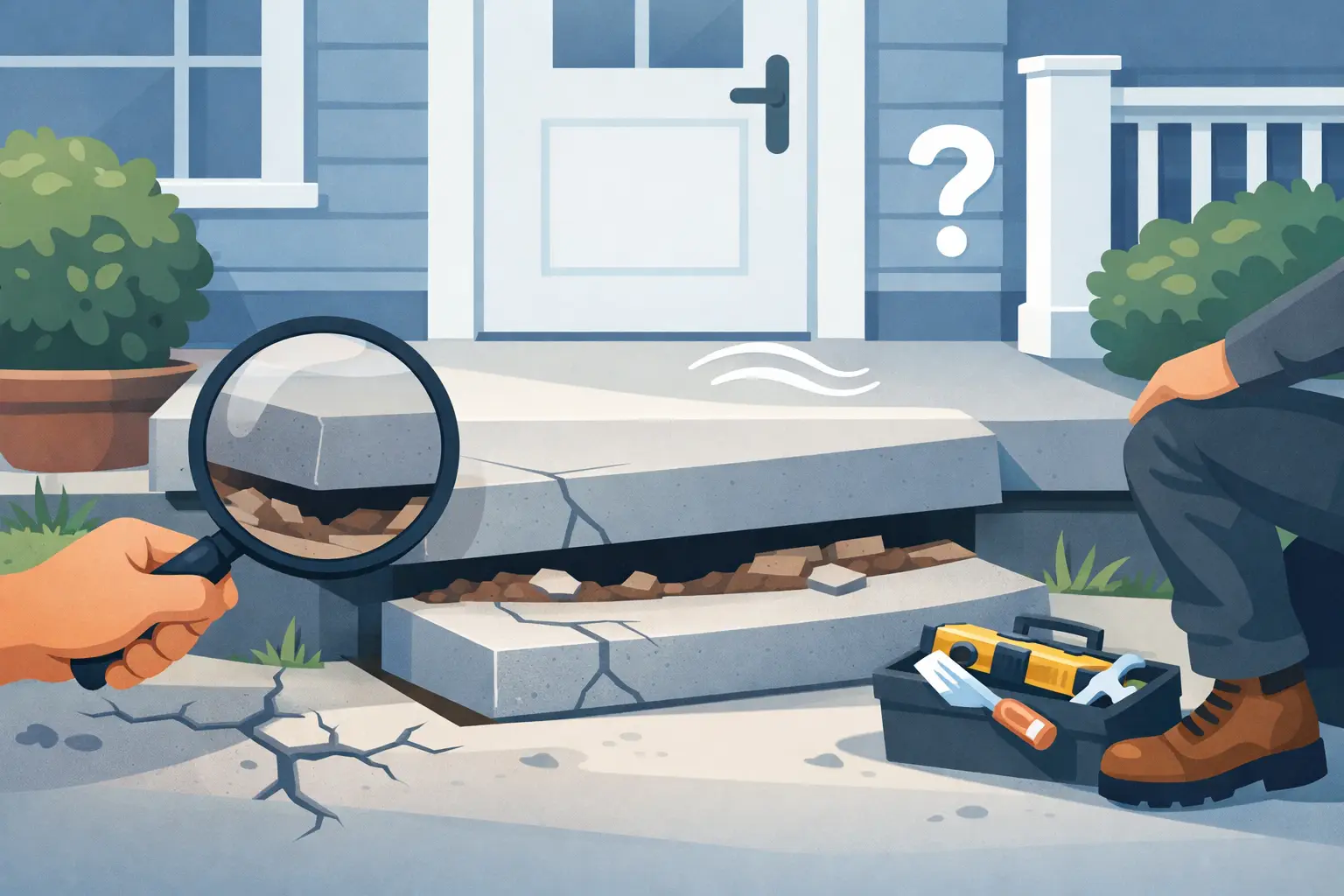
A front porch step sinking by even an inch can change the way your whole entry feels. What starts as a small drop often turns into a tripping point, a gap at the house, or a place where water starts collecting instead of draining away. In Omaha-area homes, that usually means the issue is bigger than the step itself. The concrete moved for a reason, and the right fix depends on what caused that movement.
Why front porch step sinking happens
Concrete steps do not usually sink because the concrete suddenly failed. More often, the support under the step changed. Soil can settle over time, especially around porches and stoops where backfill was placed after the home was built. If that fill was not compacted well, it may slowly compress under the weight of the step.
Water is another common reason. Downspouts that discharge too close to the porch, poor grading, or repeated runoff can wash out soil below the concrete. In Nebraska, freeze-thaw cycles can make that worse. Moisture gets into loose areas, the soil shifts, and the slab or step drops unevenly.
Tree roots, nearby excavation, and general age can also play a role, but most homeowners are dealing with one of two scenarios: gradual settlement from weak soil or washout tied to drainage. That distinction matters because lifting the step without addressing water movement may only buy time.
What a sinking porch step can tell you
Not every settled step means major structural trouble. Sometimes the problem is isolated to one precast step or a small stoop slab. In other cases, the sinking step is part of a larger pattern that includes the porch slab, adjacent walkway, or the area along the foundation.
If the step pulled away from the porch or the house, look at the size and shape of the gap. A narrow, consistent separation can point to basic settlement. A wider gap, major tilt, or cracking through connected concrete may suggest a broader support issue. If the step is sinking on one corner only, water concentration on that side is often part of the story.
You should also pay attention to door operation. If the front door suddenly sticks, that does not automatically mean the foundation is failing, but it does mean the movement may extend beyond one exterior step. A contractor will want to know whether only the step moved or whether the porch slab, entry walk, or nearby soil line changed too.
Front porch step sinking vs. full porch settlement
A single sunken step is usually easier to correct than a porch system that has settled as a unit. If the concrete step is separate from the porch slab, leveling methods may be enough to raise it back toward its original position. If the porch slab, support columns, railing attachments, and steps all shifted together, the job becomes more complex.
That is where homeowners sometimes misread the problem. The visible trip hazard is the step, but the real issue may be that the stoop, landing, or adjoining walk is no longer draining correctly. In that case, a quote should consider the surrounding concrete and water flow, not just the lowest edge.
When leveling makes sense
Concrete leveling is often a practical option when the step is structurally intact and the main problem is loss of support underneath. Mudjacking or foam injection can fill voids and raise settled concrete in many situations. For a front step, that can be a faster and less disruptive alternative to demolition and replacement.
The best candidates are steps or stoops with limited cracking, stable concrete surfaces, and enough access for the repair method being used. If the step dropped but the concrete is still in one piece, leveling may restore function and reduce the trip hazard without removing the entire structure.
There are trade-offs. Older concrete with major spalling, broken edges, or deep structural cracks may not respond well to lifting. Some steps also have construction details that limit what can be done safely, especially if they are tied tightly into masonry, brick veneer, or a larger porch structure. A step can often be lifted, but it should not be lifted blindly.
When replacement may be the better choice
Leveling is not always the right answer. If the step is badly cracked, crumbling, or built on a failing base that continues to erode, replacement may be more sensible. The same is true if the sinking revealed a larger porch problem or if the original construction was poor.
A good example is a stoop that has settled several inches, fractured across the tread, and now pitches water back toward the house. That might still be technically liftable in some cases, but the more practical path may be removing it, correcting the base and drainage, and rebuilding it properly.
This is where neutral guidance matters. Homeowners do not need a one-size-fits-all answer. They need to know whether the concrete is a decent candidate for leveling, whether the drainage issue is manageable, and whether replacement would avoid repeat work.
Drainage is often the deciding factor
If your front porch step sinking problem showed up after heavy rain, snowmelt, or repeated pooling near the entry, drainage should be part of any repair conversation. Water can move surprisingly large amounts of soil over time, especially along the edge of a porch or under adjacent walk sections.
Look for downspouts ending near the front steps, negative grading toward the house, mulch beds holding water against the stoop, or low spots in the walkway that funnel runoff toward the entry. Even small drainage defects can keep undermining the support under the concrete.
Lifting the step may correct the elevation, but if the same runoff pattern remains, the void can redevelop. Sometimes the concrete repair is straightforward and the drainage adjustment is minor. Other times, fixing the slope of nearby soil or extending downspouts is what protects the repair from failing again.
What contractors usually need to quote accurately
For a homeowner, the problem may look obvious: the step sank. For a contractor, the details determine method, price, and whether the work is even a fit. That is why quote quality improves when you gather a few specific facts before reaching out.
Photos from the front and side help show whether the step is separate from the porch slab and how severe the drop is. Measurements of the height difference are useful, even if they are approximate. It also helps to note visible cracks, gaps at the house, signs of water pooling, and whether the surrounding walkway is moving too.
Access matters more than people expect. If the step sits behind landscaping, railings, or narrow approach areas, that can affect equipment and repair options. In Omaha Slab Repair's quote-request process, these practical details are what help route a project toward contractors who can assess it realistically rather than guessing from a short description.
Signs the issue may need broader review
Some settling is localized. Some is a clue that the front entry area has wider movement. If the porch columns are out of plumb, masonry joints are separating, the porch slab has multiple crack patterns, or the walkway and front stoop are both dropping toward the house, a more complete review is worth it.
The same goes for major water intrusion in the basement or crawl space near the front wall. A sinking step does not automatically mean foundation failure, but exterior settlement and drainage problems can overlap. If several symptoms are showing up together, the repair decision should be made with that bigger picture in mind.
What to do next if your front step is sinking
Start by documenting the condition before it changes more. Take clear photos, measure the drop, and note where water goes during rain. Look for recent changes rather than relying on memory alone. A step that has been stable for years after settling is a different situation from one that dropped noticeably over one season.
Then think in terms of repair path, not just repair method. Is the concrete still solid enough for lifting? Is the movement isolated or connected to the porch and walkway? Is drainage likely part of the cause? Those questions usually matter more than whether someone calls the process mudjacking, slab jacking, or foam lifting.
Homeowners often want a quick yes-or-no answer on leveling, but front entry concrete rarely fits into a perfect rule. The best next step is to gather enough project detail that a local contractor can evaluate whether raising the step is practical, whether drainage correction should happen first, or whether replacement would be the cleaner long-term move.
A sunken front step is easy to ignore until someone catches a toe on it. It is better to treat it as an early warning sign. When you understand why it moved, you have a much better chance of fixing it once and fixing it for the right reason.